
Beyond the Democracy Media Forum: Lena Kyropoulos on Children’s Rights, Truth, and Humanity

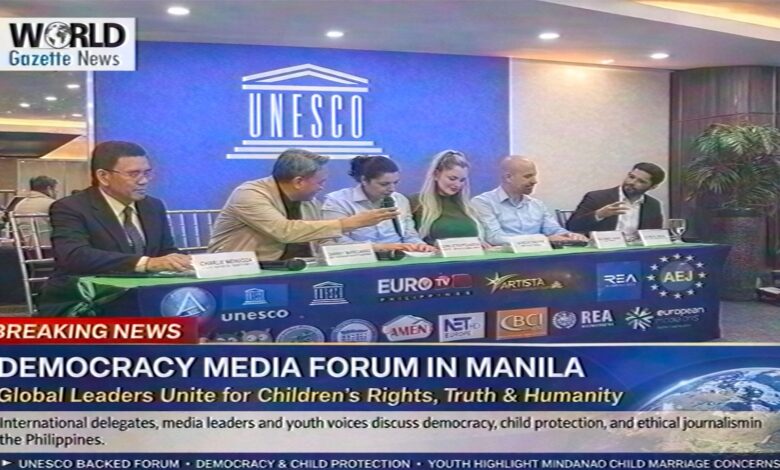
QUEZON CITY, Philippines — The Democracy Media Forum in the Philippines became more than a formal gathering of speakers and guests. It evolved into a meaningful exchange of ideas among journalists, educators, diplomats, creatives, humanitarian advocates, and young leaders who share a common concern for the future of democracy, responsible communication, human rights, and child protection in an increasingly complex world.
At a time when misinformation spreads rapidly, public trust in institutions is being tested, and social challenges continue to affect vulnerable communities, the forum created a timely space for reflection and dialogue. It reminded attendees that media is not merely a channel for headlines and publicity—it remains one of the most powerful tools for truth, accountability, and social progress.
The event was convened through the leadership of Danilo Mangahas, President and CEO of Euro TV Philippines, whose continuing work in broadcasting and civic initiatives has helped create platforms where voices from different nations and sectors can meet. Under his guidance, the forum welcomed participants from various professional backgrounds, united by the belief that communication must continue serving the public good.
Among those present were respected personalities whose diverse experiences added depth to the discussions. Dr. Shervan Taha Ameen, representing Iraq, brought the perspective of an academic and humanitarian advocate from the Kurdistan Region, where education, resilience, and peacebuilding remain vital in communities shaped by conflict. Vicky Dalli, a Greek-American actress, lawyer, and award-winning performer based in the United States, represented the cultural and creative industries, where storytelling continues to shape empathy and reflection across borders.
Also in attendance was Antonio Ma-at, Filipino author, international journalist, and founder of the Artista Achievers Awards, recognized for amplifying human stories and honoring overlooked achievers across media, arts, and leadership. Helen Sarita, a respected Filipino literary voice, represented the enduring role of poetry, literature, and cultural expression in preserving identity and inspiring communities. Adrian Fisgua Luage likewise contributed to the forum’s spirit of collaborative participation, symbolizing the role of emerging professionals in shaping future civic and media engagement.
Yet one of the strongest dimensions of the event came from the participation of younger attendees and students who shared their own perspectives on urgent social realities in the Philippines. Their voices added honesty and immediacy to the discussions. They raised concerns about child welfare, poverty, unequal access to education, exploitation, and the persistence of early or forced marriage practices affecting some communities in Mindanao—issues often tied to tradition, economic hardship, insecurity, and long-standing social structures.
Their presence reminded the room that conversations about democracy and rights cannot remain limited to institutions and experts alone. The younger generation lives closest to the consequences of today’s policies and cultural choices. They are not simply future stakeholders—they are already participants in the present.
Among the distinguished international attendees was Lena Kyropoulos, a respected Greek journalist, evaluator, international affairs professional, and cultural ambassador whose work spans diplomacy, media, international cooperation, and civic engagement. While her credentials were impressive, what stood out even more was the sincerity with which she spoke.
Following the public program, I had the opportunity to sit down with her personally. What followed felt less like a formal interview and more like an honest conversation about children, truth, humanity, and the direction our world is taking.
Children First: The Measure of Civilization
When the discussion turned to children, her tone immediately became more serious. It was clear this was not a ceremonial topic for her, nor a subject mentioned simply because it was expected in international forums. It was personal conviction.
She spoke firmly about the need to protect children from exploitation, abuse, trafficking, emotional neglect, and systems that deny them safety or dignity. At one point, she said with visible concern:
“They stole the children’s life.”
The statement was brief, but powerful. It captured the tragedy of childhoods disrupted by violence, poverty, displacement, or harmful social systems. For Lena, children are not statistics, beneficiaries, or symbolic causes. They are the foundation of every society’s future.
She emphasized that nations cannot claim progress while allowing children to suffer in silence. Economic development, political success, or technological advancement lose moral meaning when the youngest members of society are unprotected.
In her view, children need more than food and schooling. They need environments shaped by empathy, discipline, compassion, responsibility, and love. Too many societies, she suggested, now teach ambition before character and competition before conscience.
Her words echoed one of the central messages of the forum itself: the quality of a nation’s future can often be measured by the quality of its childhoods.
Europe Awakening: Protection Over Silence
Lena also highlighted that Europe has recently strengthened child protection frameworks. Across several EU jurisdictions, stricter safeguarding measures now place greater responsibility on institutions to act when children may be at risk. Teachers, doctors, and social workers are increasingly subject to mandatory reporting duties when they suspect forced marriage, trafficking, abuse, or other forms of exploitation involving minors.
In addition, many countries now fund NGOs, shelters, and 24/7 hotlines dedicated to helping children and teenagers who fear being sent abroad for forced marriage or are vulnerable to trafficking. Partnerships linked to global advocacy groups have helped expand emergency response systems and community education.
For Lena, these changes signal something important: Europe is slowly moving from being a passive observer to becoming an active protection guard. That shift matters not only legally, but morally. It tells children that society is beginning to take responsibility for their safety instead of leaving them alone to navigate danger.
Safety Has Biological Meaning
She then spoke about something rarely discussed in political forums: the biology of safety.
When children feel secure, supported, and protected, the body can activate the parasympathetic nervous system—the system associated with rest, recovery, trust, and healthy development. In calmer states, hormones linked to bonding and wellbeing, such as oxytocin, may increase. This helps emotional regulation, learning, connection, and resilience.
But when children live under chronic fear, violence, coercion, or uncertainty, the body may remain in stress mode. Elevated cortisol over long periods can affect mood, concentration, sleep, immunity, and development. Anxiety is not only psychological—it can become physiological.
Her point was simple but profound: children must not only feel safe; they must actually be safe. Real protection creates healthier individuals, and healthier individuals create healthier communities. Fear spreads stress. Safety spreads balance.
The Philippines Through Her Eyes
When asked about her impressions of the Philippines, her expression softened.
Her journey to the country had not been easy. Like many international travelers, she experienced delays, cancellations, exhaustion, and moments of physical discomfort. Yet what remained strongest in her memory was not inconvenience, but kindness.
She spoke warmly of airport staff checking on her wellbeing, strangers offering help naturally, and ordinary people showing concern without expecting anything in return. She described Filipinos as respectful, caring, warm, and sincerely attentive to others.
For someone who has traveled internationally and interacted with many cultures, the praise felt thoughtful rather than casual.
She seemed to recognize in the Philippines something many modern societies risk losing—the instinct to care for others without needing reward or recognition.
Some countries develop systems. Others preserve soul.
Through her eyes, the Philippines still carries much of that human warmth.
Journalism as Duty, Not Performance
Our conversation then turned to journalism, a subject she approached with seriousness and clarity.
Lena does not romanticize media work. She has seen enough of the world to understand that journalism is not glamour, celebrity, or visibility. It is responsibility.
She spoke of communities affected by conflict, families enduring hardship, and realities that never fully fit inside headlines. Facts matter deeply, she said, but facts without humanity become sterile.
Statistics can describe suffering, but they rarely communicate emotional truth.
A child trapped in war, a parent sacrificing comfort for survival, an elderly person carrying family burdens, a community rebuilding after trauma—these stories require more than numbers. They require context, empathy, and the courage to tell them honestly.
She also warned against media systems becoming overly dependent on political interests, commercial sponsors, or the pursuit of popularity. Once truth begins to seek permission, it starts losing its shape.
That is why independent journalism, in her view, remains essential to democratic life. It protects the possibility that facts can still matter more than convenience.
A Voice of Conviction
What stayed with me after the conversation was not merely her résumé, international experience, or professional accomplishments.
It was the seriousness with which she still believes in values many now treat lightly.
She believes in truth.
She believes in kindness.
She believes children deserve protection.
She believes technology should serve humanity, not replace it.
She believes nations can still become friends.
She believes growth comes through humility, learning, and shared responsibility.
The Democracy Media Forum provided a stage where many voices were heard, ideas were exchanged, and urgent concerns were raised.
But in a quieter conversation afterward, Lena Kyropoulos offered something deeper than commentary.
She offered conviction.
She offered perspective.
She offered hope.
And in a world crowded with noise, those remain among the rarest and most necessary qualities of all.
Editor: Antonio Ma-at


